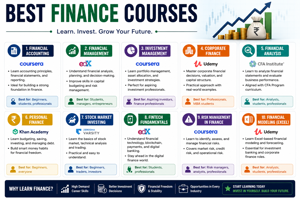
Best Finance Courses: Eligibility, Salary & Career Scope in 2026
If you've ever wondered how money moves through the global economy — and how some people build incredible careers just by understanding it — finance might be your calling. Whether you're a fresh 12th-grade graduate, a working professional looking to upskill, or a non-commerce student curious about switching tracks, the right finance course can completely transform your career trajectory.
In this guide, we break down the best finance courses eligibility and career scope across India and the world — so you can make a decision that actually makes sense for your life.
Why a Finance Career Is a Smart Choice in 2026
The global financial services industry employs millions and continues to grow. From fintech startups to global investment banks, demand for finance professionals is at an all-time high. In India alone, the BFSI sector is projected to create over 1.5 million jobs by 2027 — making finance one of the most future-proof career paths available today.
What Should Students Consider Before Choosing a Finance Course?
Before you enroll in any program, take a step back and ask yourself a few honest questions. Choosing the wrong course wastes both time and money.
- Your current education level — Some courses are designed for 12th-grade students, while others require a graduation degree or work experience.
- Career goal clarity — Do you want to be an investment banker, financial planner, risk analyst, or accountant? Your goal shapes your course choice.
- Budget and duration — Online finance courses with certification can cost as little as ₹5,000, while an MBA in finance can run ₹10–25 lakhs. Know what you can invest.
- Recognition and credibility — Look for globally recognized certifications like CFA, CFP, or FRM rather than obscure certificates with little market value.
- Mode of learning — Full-time, part-time, or online? Best finance courses for working professionals are often available in flexible formats.
- Placement support — If you're a fresher, prioritize institutions offering best finance courses with placement assistance.
- Industry demand — Research which finance roles are hiring actively in your target market — India, the US, UK, or elsewhere.
Benefits of Choosing a Finance Course
The advantages go beyond just landing a job. Here's what a quality finance education actually gives you:
- High earning potential — Finance professionals among the highest-paid across sectors. A CFA charterholder in India earns ₹8–25 LPA on average.
- Global career mobility — Certifications like CFA and FRM are recognized worldwide, giving you the freedom to work internationally.
- Diverse career paths — From corporate finance and investment banking to personal financial planning and fintech, the options are wide.
- Entrepreneurship edge — Understanding finance helps you run a business smarter, manage cash flow, and attract investors.
- Job stability — Finance roles exist in every industry — healthcare, tech, real estate, government — making your skills universally useful.
- Continuous learning culture — Finance keeps evolving with new regulations, markets, and technology, keeping your career intellectually stimulating.
Best Finance Courses for Students Starting Their Financial Career
Top Finance Courses After 12th — Eligibility & Career Scope
If you've just finished school, these undergraduate programs lay a strong foundation:
- B.Com (Bachelor of Commerce) — Eligibility: 10+2 in any stream (commerce preferred). Duration: 3 years. Leads to roles in accounting, taxation, and banking.
- BBA in Finance — Eligibility: 10+2 with 50%+ marks. Duration: 3 years. Great entry point into corporate finance and management roles.
- B.Sc. in Economics — Eligibility: 10+2 with Mathematics. Builds strong analytical and financial modeling skills.
- Integrated MBA (Finance) — 5-year program combining BBA and MBA. Ideal for students committed to a finance management career from the start.
These are among the best finance courses after 12th for students who want to build a strong academic base before entering the workforce.
Best Finance Courses After Graduation — Eligibility & Career Opportunities
- MBA in Finance — Eligibility: Any graduate with 50%+ marks + valid CAT/GMAT/XAT score. One of the best finance degree programs for career advancement. Salary range: ₹6–30 LPA depending on the college.
- M.Com (Master of Commerce) — Eligibility: B.Com or equivalent. Duration: 2 years. Focuses on accounting, taxation, and financial management.
- Finance Courses After B.Com — Options include CA, CMA, CFA, or specialized PG diplomas in banking and financial services.
Top Finance Certification Courses for Beginners
Not everyone needs a full degree. These best finance certification courses for beginners offer real value without multi-year commitments:
- NISM Certifications (India) — Eligibility: Anyone. Duration: Self-paced. Ideal for those entering stock markets, mutual funds, and securities.
- Google Finance Fundamentals / Coursera Finance Courses — Eligibility: None. Great online finance courses with certification for absolute beginners.
- CFA Institute's Investment Foundations — A free entry-level certificate for those exploring the investment world.
- NSE Academy Courses — Short-term professional finance courses in India for market enthusiasts and banking aspirants.
- Diploma in Banking & Finance (DBF) — Offered by IIBF; ideal for those targeting public sector banking jobs.
Best Finance Courses Based on Career Goals
Different goals need different paths. Here's a clear mapping:
- Want to work in investment management? → CFA (Chartered Financial Analyst) is the gold standard globally.
- Want to do personal financial planning? → CFP (Certified Financial Planner) is purpose-built for this.
- Interested in risk management? → FRM (Financial Risk Manager) is preferred by top banks and insurance firms.
- Targeting corporate finance or C-suite roles? → MBA in Finance from a reputed B-school is the smartest route.
- Looking for finance courses for non-commerce students? → CFA Level 1 and online courses on Coursera/edX accept candidates from any background.
- Working professional wanting to upskill? → CFA, CFP, or an Executive MBA are among the best finance courses for working professionals.
Comparison of Popular Finance Certifications
| Certification | Full Form | Eligibility | Duration | Average Salary (India) | Global Recognition |
|---|---|---|---|---|---|
| CFA | Chartered Financial Analyst | Bachelor's degree or final year student | 2–5 years | ₹8–25 LPA | Very High |
| CFP | Certified Financial Planner | 10+2 (for exam); graduation for full certification | 6–12 months | ₹4–15 LPA | High |
| FRM | Financial Risk Manager | No formal requirement | 1–2 years | ₹7–20 LPA | Very High |
| CA | Chartered Accountant | 10+2 (CPT route) or graduate (Direct Entry) | 3–5 years | ₹6–30 LPA | High (India/UK) |
| CMA | Cost & Management Accountant | 10+2 | 3–4 years | ₹5–18 LPA | Moderate–High |
| MBA Finance | Master of Business Administration | Graduation + entrance exam | 2 years | ₹6–30 LPA | High |
Skills Students Need for a Successful Finance Career
Technical knowledge alone won't take you far. Here's what top finance employers actually look for:
- Financial modeling and Excel proficiency — Non-negotiable for most analyst roles.
- Understanding of financial statements — Balance sheet, P&L, cash flow analysis are core reading skills.
- Analytical thinking — The ability to interpret data and draw meaningful conclusions.
- Communication skills — Finance professionals present complex data to non-finance audiences regularly.
- Knowledge of financial regulations — SEBI, RBI guidelines in India; SEC, IFRS globally.
- Risk assessment ability — Especially crucial for roles in banking, insurance, and investment management.
- Programming basics — Python and SQL are increasingly valued in finance roles involving data analysis.
Career Opportunities After Completing Finance Courses
The career scope in finance is genuinely wide. Here are real paths graduates pursue:
- Investment Banker — Helps companies raise capital, execute mergers, and navigate IPOs. High-pressure, high-reward.
- Financial Analyst — Analyzes market data, prepares reports, and supports investment decisions.
- Chartered Financial Analyst (CFA) — Works in portfolio management, equity research, and asset management.
- Financial Planner / CFP — Advises individuals on investments, retirement, insurance, and tax planning.
- Risk Manager / FRM — Identifies and mitigates financial risks for banks and corporates.
- Corporate Finance Manager — Manages budgeting, forecasting, and capital allocation for companies.
- Fintech Analyst — Works at the intersection of finance and technology in startups or digital banks.
- Credit Analyst — Evaluates loan applications and creditworthiness for banks and NBFCs.
- Tax Consultant — Advises businesses and individuals on tax planning and compliance.
- Actuarial Analyst — Uses statistics and finance principles in insurance and pension industries.
These are among the best finance courses with high salary outcomes — especially CFA, MBA Finance, and FRM holders in metro cities.
Common Mistakes Students Make While Choosing Finance Courses
Learning from others' mistakes is the smarter path:
- Chasing prestige over fit — Enrolling in an MBA just for the brand without understanding if it aligns with your goals.
- Ignoring eligibility requirements — Some students apply for CFA or FRM without checking if they meet the prerequisites.
- Not researching placement records — Choosing a college without verifying its actual placement history in finance roles.
- Skipping foundational courses — Jumping into advanced programs without a solid base in accounting or economics.
- Underestimating online certifications — Many dismiss online finance courses with certification, but platforms like Coursera (partnered with Yale and Wharton) offer world-class content.
Roadmap to Start a Successful Financial Career
Here's a practical, step-by-step path you can follow:
- Step 1: Assess your starting point — Are you in 12th grade, a graduate, or a working professional? Your starting point determines your first move.
- Step 2: Choose a specialization — Investment banking, financial planning, risk management, or corporate finance. Pick one and go deep.
- Step 3: Build academic foundations — Complete a relevant degree (B.Com, BBA, B.Sc. Economics) or start with beginner certification courses.
- Step 4: Pursue a recognized certification — Target CFA, CFP, or FRM based on your chosen path.
- Step 5: Gain practical experience — Apply for internships, freelance financial analysis projects, or part-time roles at NBFCs or startups.
- Step 6: Build a professional network — Join LinkedIn groups, attend NISM or CFA Institute events, and connect with finance professionals.
- Step 7: Keep learning — Finance evolves fast. Follow RBI circulars, SEBI updates, and global market news regularly.
- Step 8: Apply strategically — Target companies that match your specialization. Use placement cells, job portals, and referrals.
Final Thoughts About a Financial Career
Finance is one of the few fields where smart choices compound over time — just like money itself. Whether you go for a CFA, an MBA, or start with beginner online courses, consistency and the right course choice will define your outcomes. Start where you are, choose wisely, and keep building.
FAQs Related to Financial Career
1. Which is the best finance course after 12th for a student with no commerce background?
Students from science or arts backgrounds can start with BBA Finance, B.Sc. Economics, or beginner-level online finance courses on platforms like Coursera. CFA also accepts students from any stream.
2. Is CFA better than MBA in Finance?
Both have strong career value but serve different purposes. CFA is ideal for investment management and research roles. MBA Finance is better for corporate finance, consulting, and general management tracks.
3. What is the eligibility for the FRM certification?
There is no formal educational requirement to appear for the FRM exam. However, to earn the FRM designation, candidates need two years of relevant work experience in financial risk management.
4. Are online finance courses with certification worth it in 2026?
Absolutely. Courses from platforms like Coursera (Yale, Wharton), edX (MIT, Columbia), and NSE Academy carry real credibility. Many hiring managers actively value them, especially for entry-level and mid-level roles.
5. What is the average salary after completing a finance course in India?
It varies by course and role. A fresh B.Com graduate earns ₹2.5–4 LPA, an MBA Finance graduate from a top school earns ₹8–20 LPA, while experienced CFA or FRM professionals can earn ₹15–35 LPA or more.