Best Networking Courses for Beginners and How to Get Started?
If you've ever wondered how the internet works, how files transfer between computers, or how companies keep their data secure — you're already asking the right networking questions. And here's the thing: you don't need a computer science degree to figure it out. The best networking courses for beginners are designed exactly for people like you — curious, motivated, and starting from zero.
Whether you're an IT newcomer, a career-switcher, or just someone who wants to stop feeling lost when their router starts blinking, this guide will walk you through everything — what networking actually is, which courses are worth your time, and how to get started learning networking from scratch.
About Networking Course
A networking course teaches you how computers, devices, and systems communicate with each other. You'll learn concepts like IP addressing, protocols, subnets, routers, and firewalls. These courses range from free beginner videos to full certification programs and are suitable for anyone — no prior IT experience is required.
Why Learning Networking is Essential for Beginners
You might be wondering — is networking still relevant? Absolutely. In fact, it's more relevant than ever.
- Every IT role touches networking. Whether you're in cybersecurity, cloud computing, systems administration, or software development, understanding how data moves is non-negotiable.
- High demand, strong salaries. Network engineers and administrators remain among the most in-demand IT professionals globally. According to the U.S. Bureau of Labor Statistics, network and computer systems administrators earn a median salary of around $90,000 per year.
- Foundation for certifications. Big names like CompTIA Network+, Cisco CCNA, and AWS certifications all require a solid understanding of networking fundamentals.
- Great for career changers. Many networking courses for beginners with no experience required are available online, meaning you can learn at your own pace without quitting your current job.
- Cybersecurity starts here. You can't protect a network you don't understand. Networking basics are the gateway to ethical hacking and cybersecurity roles.
- Remote work and cloud reliance. As more businesses move to the cloud, professionals who understand how networks connect and secure distributed systems are incredibly valuable.
Types of Networking Courses for Beginners
Not all networking courses are built the same. Here's a breakdown to help you understand what's out there:
| Course Type | Description | Best For | Cost |
|---|---|---|---|
| Free Online Courses | Video-based, self-paced learning with no cost | Absolute beginners exploring the field | Free |
| Paid Online Courses | Structured curriculum with instructor support | Learners wanting guided, in-depth content | $15–$200 |
| Certification Prep Courses | Designed around exams like CompTIA Network+ or CCNA | Those targeting a specific credential | $50–$500 |
| University/College Programs | Formal degrees or diplomas in networking | Long-term career investment | Varies |
| Self-Paced Bootcamps | Intensive, project-based online programs | Career switchers moving quickly | $200–$2,000 |
| YouTube/Free Platforms | Community-created tutorials and walkthroughs | Learners who prefer video on-demand | Free |
Top Networking Courses for Beginners
Here are some of the most trusted and well-reviewed options across both free and paid categories:
Free Networking Courses for Beginners
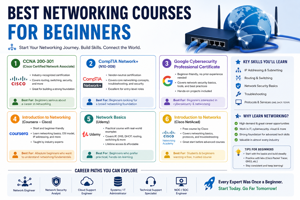
- Cisco Networking Academy – Introduction to Networks (ITN)
One of the most respected free networking courses online for beginners, Cisco's NetAcad platform offers structured content with labs, quizzes, and real-world scenarios. It's the foundation for the CCNA certification path. - Google IT Support Certificate (Coursera)
Covers networking basics as part of a broader IT support curriculum. You can audit individual modules for free, or pay for the full certificate. It's beginner-friendly and job-focused. - Professor Messer's CompTIA Network+ Course (YouTube/Website)
If you're targeting the Network+ certification, Professor Messer's free video series is a go-to resource. Clear, no-fluff explanations of every networking fundamental topic. - Khan Academy – Internet 101
A very basic but effective starting point for people who want to understand how the internet works before diving deeper.
Paid and Certification-Focused Courses
- CompTIA Network+ Study Course (Udemy – Mike Meyers or Jason Dion)
These are among the best networking certification courses for beginners on Udemy. Frequently on sale for under $20, they cover everything from OSI models to wireless networking, with practice exams included. - Cisco CCNA 200-301 Complete Course (Udemy – David Bombal)
A highly rated, comprehensive course for those aiming at the CCNA. It includes packet tracer labs so you get hands-on practice without needing physical hardware. - CBT Nuggets – CompTIA Network+
A subscription-based platform known for its high-quality instructors. Great for self-paced networking courses for beginners online who want premium video content. - LinkedIn Learning – Networking Foundations
Good for professionals wanting to understand networking in a business context. LinkedIn Learning is included free with many library memberships.
How to Choose the Right Networking Course
With so many options, picking the right one matters. Here's what to look for:
- Define your goal first. Are you studying for a certification like Network+ or CCNA? Looking to get a job in IT? Or just satisfying personal curiosity? Your goal determines the course type.
- Check if certification is included. If career growth is your aim, go for the best networking course for beginners with certification like CompTIA or Cisco pathways.
- Look for hands-on labs. Networking is practical. Courses that include simulations, packet tracers, or virtual labs will help you retain concepts far better than videos alone.
- Read recent reviews. Technology moves fast. A course from 2019 might teach outdated protocols. Always check when the material was last updated.
- Consider your learning style. If you prefer self-paced study, platforms like Udemy or Coursera are great. If you want structured deadlines and community, a bootcamp might serve you better.
- Start free, then invest. There's no need to spend money on day one. Begin with a free networking course online for beginners, confirm your interest, then upgrade to a paid or certification course.
Step-by-Step Guide to Getting Started in Networking
Not sure where to begin? Here's a practical, no-overwhelm approach to how to start learning networking from scratch as a beginner:
- Step 1 – Learn the basics of how the internet works: Start with free resources like Cisco NetAcad's "Introduction to Networks" or a YouTube series. Understand what a network is, what a router does, and how devices get IP addresses.
- Step 2 – Understand the OSI and TCP/IP models: These are the backbone of all networking knowledge. Don't skip this step — every advanced topic builds on these models.
- Step 3 – Get familiar with key concepts: Study subnetting, DNS, DHCP, VLANs, and basic network security concepts. These show up on every major networking exam and in real job environments.
- Step 4 – Practice with simulators: Download Cisco Packet Tracer (free) or GNS3 to start building virtual networks. Practical experience accelerates learning dramatically.
- Step 5 – Pick a certification path: CompTIA Network+ is the most beginner-friendly and vendor-neutral. CCNA is slightly more advanced but widely recognized. Choose one and build your study plan around it.
- Step 6 – Join communities: Reddit's r/networking and r/ccna, as well as study groups on Discord and LinkedIn, are full of learners and professionals happy to answer questions. You don't have to figure it out alone.
- Step 7 – Schedule your exam and commit: Set a target date. Having a deadline keeps you accountable and focused. Most people studying part-time can be exam-ready within 3–6 months.
Benefits of Doing a Networking Course
Still on the fence? Here's why investing your time in a foundational networking course for beginners is a smart move:
- Opens doors to high-demand IT careers like network administration, cloud engineering, cybersecurity, and systems support.
- Provides a globally recognized credential when you complete certification-aligned courses — something employers actively look for.
- Builds problem-solving skills you use daily, from troubleshooting home internet issues to diagnosing enterprise-level outages.
- Creates a strong foundation for advanced learning in areas like cloud computing (AWS, Azure), ethical hacking, and DevOps.
- Flexible learning options mean you can fit study into any schedule — whether you're working full-time or studying as a student.
- Boosts earning potential. Certified networking professionals consistently earn more than their non-certified peers, with CompTIA Network+ holders averaging competitive salaries in the IT support and admin space.
- Increases confidence in technical environments — you'll stop feeling intimidated in conversations about infrastructure, security, or system performance.
Final Thoughts About Networking Courses
Networking is one of those skills that never goes out of style. As technology evolves, the demand for people who understand how systems talk to each other only grows stronger. The best networking courses for beginners are more accessible than ever — many are free, self-paced, and built for people with zero background. The only thing standing between you and a career in IT networking is your first step.
Pick a course, start today, and stay consistent. Within a few months, you'll be surprised how much ground you can cover.
FAQs Related to Networking Courses
Q1. Can I learn networking with no prior IT experience?
Yes, absolutely. Most beginner networking courses are designed for people with zero technical background. Platforms like Cisco NetAcad, Coursera, and Udemy all offer networking courses for beginners with no experience required. You'll be introduced to concepts gradually, so there's no steep learning cliff at the start.
Q2. How long does it take to complete a networking course for beginners?
It depends on the course type and how much time you dedicate. A free introductory course can be completed in 2–4 weeks with consistent effort. A full certification prep course like CompTIA Network+ typically takes 2–4 months when studied part-time (1–2 hours per day).
Q3. What is the best free networking course online for beginners?
Cisco Networking Academy's "Introduction to Networks" is widely regarded as one of the best computer networking courses for beginners that are free. It's structured, comprehensive, and directly aligned with industry certifications. Professor Messer's Network+ series on YouTube is another excellent free resource.
Q4. Which networking certification is best for a complete beginner?
CompTIA Network+ is the most recommended starting certification. It's vendor-neutral, widely recognized by employers, and specifically designed for those early in their IT careers. After Network+, many learners move on to Cisco CCNA for more advanced networking roles.
Q5. Are online networking courses as good as classroom training?
For most beginners, yes — especially when the course includes hands-on labs or simulators. Modern networking training courses for beginners online are interactive, regularly updated, and often more affordable than classroom options. Many certified networking professionals built their entire knowledge base through self-paced online learning.