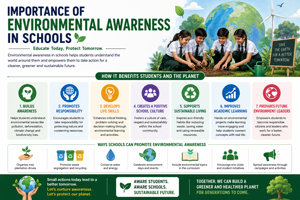
Importance of Environmental Awareness in Schools
Imagine handing a child a world that’s already sort of broken, and then saying “Fix it.” That’s kinda what could happen if we keep postponing environmental education, over and over. The thing is, what kids learn early, the routines and small habits, they tend to stay with them for life.
And schools, honestly, are among the strongest places to build those habits in the first place. Environmental awareness in schools matters way beyond the usual classroom content. It influences how the next generation thinks, behaves and also how they value the planet they’ll be living on.
Why Environmental Awareness Matters Today
Our planet is facing some real, pressing stuff— rising temperatures, fewer forests, murkier water bodies, and wildlife that just keeps vanishing. Environmental awareness isn’t only a trend either, it’s basically a necessity.
When people really grasp how they’re linked to the natural world, they tend to make better choices, not just for themselves, but also for their neighborhood and, in the long run, for earth itself.
What Is Environmental Awareness in Schools?
Environmental awareness in schools refers to the process of helping students understand environmental issues, their causes, and what they can do about them. It includes lessons on nature, sustainability, conservation, and responsible living — woven into daily school life through curriculum, activities, and community involvement.
Why Environmental Awareness Is Important for Students
Teaching students about the environment isn't just about facts and figures. It's about shaping values and giving young people the tools to make a difference. Here's why it matters:
- It builds a sense of responsibility — Students who understand how pollution or deforestation works are more likely to think twice before littering or wasting water.
- It connects learning to real life — Environmental topics make subjects like science, geography, and math more relevant and meaningful.
- It encourages critical thinking — Students learn to ask why climate change happens, what drives it, and what solutions actually work.
- It promotes physical and mental well-being — Spending time in nature and learning about it is proven to reduce stress and improve focus in children.
- It prepares future leaders — Many of today's students will grow up to become policymakers, engineers, and entrepreneurs. Environmental literacy development in schools gives them the foundation to lead sustainably.
- It cultivates empathy — Learning about endangered species or communities affected by floods helps children develop compassion for both nature and people.
- It strengthens community bonds — School-based environmental projects often bring together students, teachers, parents, and local organizations around a shared goal.
Key Benefits of Environmental Awareness Programs in Schools
The benefits of environmental awareness programs in schools stretch beyond the classroom walls. When schools invest in eco‑conscious education, the ripple effects are significant:
- Long-term behavioral change — Children who learn about sustainability early are far more likely to adopt eco-friendly habits as adults, from reducing plastic use to supporting green policies.
- Improved academic engagement — Environmental themes make learning more hands-on and project-based, which research consistently shows boosts student participation and retention.
- Stronger environmental literacy — Students develop the ability to read, understand, and respond to environmental information — a crucial skill in today's data-driven world.
- Reduced carbon footprint on campus — Schools that teach sustainability often implement what they preach — energy-saving measures, recycling programs, and school gardens.
- Healthier school environments — Greener campuses with plants, gardens, and cleaner air directly benefit students' physical health and concentration.
- Community-level impact — Students take their knowledge home, influencing family behaviors and even inspiring broader community action.
- Economic awareness — Understanding conservation education helps students see the economic logic behind renewable energy, waste reduction, and sustainable agriculture.
Effective Ways Schools Can Promote Environmental Awareness
The role of schools in creating environmental awareness is more than adding a lesson here and there. It requires intentional, ongoing effort. Here's what works:
- Integrate it into the core curriculum — An environmental awareness curriculum in schools should be part of science, social studies, and even language arts — not a one-off event.
- Start school gardens and composting programs — These hands-on initiatives teach students about food systems, waste reduction, and the value of soil health.
- Organize nature walks and outdoor education — Getting students outside the classroom and into natural spaces builds a genuine connection with the environment.
- Host eco-awareness campaigns and events — School-based environmental awareness initiatives like tree-planting drives, Earth Day events, or "no plastic week" campaigns make learning memorable.
- Incorporate technology — Apps, documentaries, and interactive tools can make environmental data tangible and help students visualize issues like deforestation or ocean pollution.
- Celebrate environmental milestones — Acknowledging progress, like reducing school waste by 30%, motivates students and reinforces positive behavior.
- Establish a Green Club or Eco Committee — Student-led groups are excellent for promoting environmental literacy in schools and ensuring the message reaches every corner of the campus.
- Collaborate with local environmental organizations — Real partnerships with NGOs or government bodies give students access to expertise, field visits, and real-world projects.
The Role of Teachers in Building Environmental Awareness
Teachers are the most direct link between students and the ideas that shape their worldview. When it comes to fostering eco‑consciousness in school students, teachers play a central role:
- Model sustainable behavior — A teacher who brings a reusable water bottle and switches off lights sets a quiet but powerful example.
- Make lessons relatable — Connecting global issues to local realities helps students feel that environmental problems are their concern, not just someone else's.
- Encourage curiosity and questioning — Great environmental educators don't just teach answers; they help students ask better questions about how the world works.
- Use interdisciplinary approaches — Teaching environmental sustainability in schools is most effective when it's connected across subjects rather than siloed in one class.
- Create safe spaces for discussion — Environmental issues can feel overwhelming. Teachers who acknowledge this and allow open discussion help students process complex emotions alongside facts.
- Stay updated — Environmental science is evolving quickly. Teachers who engage with ongoing professional development bring fresher, more accurate knowledge into the classroom.
- Assign meaningful projects — Instead of rote assignments, teachers can ask students to analyze their community's waste management system or design a water-saving solution for their school.
The Role of Parents and Communities in Supporting Environmental Education
Environmental education doesn't end at the school gate. Parents and communities have a big part to play in reinforcing what students learn:
- Practice what you preach at home — When parents recycle, conserve energy, and shop sustainably, it validates what children are learning in school.
- Engage with school programs — Attending environmental events, volunteering for clean-up drives, or joining parent eco-committees shows children that adults take these issues seriously.
- Explore nature together — Weekend hikes, visits to nature reserves, or simply tending a home garden deepen a child's environmental connection.
- Limit single-use plastics as a family — Small changes at home, made visible to children, reinforce conservation habits far more powerfully than any textbook.
- Support school initiatives financially and socially — Community funding for school gardens, rainwater harvesting systems, or solar panels turns environmental protection awareness in educational institutions into reality.
- Talk about environmental news — Discussing current events like local pollution issues or wildlife conservation efforts helps children see these topics as part of everyday life, not just school assignments.
Challenges in Promoting Environmental Awareness in Schools
Even with the best intentions, there are real hurdles schools face in building strong environmental education programs:
- Curriculum overload — Teachers are already juggling packed syllabuses. Adding environmental content without proper support or time allocation can feel impossible.
- Lack of resources — Not every school has access to green spaces, lab equipment, or the budget for extracurricular environmental programs.
- Teacher training gaps — Many educators haven't had formal training in environmental science or sustainability pedagogy, making it harder to teach these topics with confidence.
- Inconsistent policy support — Without clear government mandates or institutional backing, environmental education can vary wildly from one school to another.
- Socioeconomic barriers — Schools in lower-income areas may prioritize immediate academic pressures over long-term sustainability projects — not because they don't care, but because resources are stretched thin.
- Short attention spans and digital distractions — Competing for student attention in a screen-heavy world makes deep, reflective learning about nature more challenging.
- Disconnect between knowledge and action — Students may understand environmental issues intellectually but not know how to translate that into meaningful action in their daily lives.
Addressing these challenges requires collaboration between governments, educators, communities, and parents — and a shared belief that cultivating environmental responsibility in students is worth every effort.
Conclusion: Building a Greener Future Through Environmental Awareness in Schools
The importance of environmental awareness in schools can't really be overstated, not even a little. When schools make space for this type of learning, they are not only teaching facts — they're also molding values, daily habits, and maybe even some futures. Every child who learns to care for the earth today becomes a kind of steward, later on, tomorrow.
FAQs About Environmental Awareness in Schools
1. Why is environmental awareness important in schools?
Environmental awareness in schools helps students understand the impact of human actions on nature. It builds responsible habits early, develops critical thinking, and prepares young people to make sustainable choices throughout their lives.
2. What are some effective school-based environmental awareness initiatives?
Schools can run tree-planting drives, start composting programs, create student-led eco clubs, organize clean-up campaigns, and integrate sustainability into everyday lessons. Partnering with local environmental groups also brings real-world relevance to classroom learning.
3. How can teachers promote environmental sustainability in schools?
Teachers can model eco-friendly behavior, use project-based learning, connect environmental topics across subjects, and create opportunities for students to engage with local environmental issues. Ongoing professional development in sustainability education also helps.
4. What is the role of parents in supporting environmental education?
Parents can reinforce school learning by practicing sustainable habits at home, discussing environmental news, participating in school eco-events, and spending time in nature with their children. When home and school send the same message, the impact is far stronger.
5. What are the main challenges in implementing environmental awareness programs in schools?
Common challenges include limited budgets, overcrowded curricula, lack of teacher training, inconsistent policy support, and socioeconomic disparities between schools. Overcoming these requires committed leadership, community involvement, and government policy that prioritizes environmental literacy development in schools.