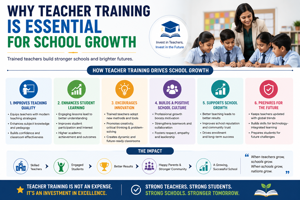
Why Teacher Training Is Essential for School Growth
Every great school has one thing in common — great teachers. But great teachers are not born overnight. They are shaped through consistent learning, feedback, and practice. That is exactly why teacher training is not just a box to tick on a school's annual planner. It is the single most powerful investment a school can make.
Think about it this way: you would not ask a doctor to treat patients without regular medical updates. So why would a school expect teachers to prepare students for a fast-changing world without giving them the tools to grow? When schools take teacher development seriously, everything else follows — student performance improves, classroom culture shifts, and the school itself moves forward. It truly is interconnected.
In this article, we are going to break down why teacher training is essential for school growth — not just in theory, but in real, practical terms.
About Teacher Training and Its Importance
Teacher training is a structured process through which educators build and refine the skills needed to teach effectively. It covers pedagogy, classroom management, subject knowledge, and student psychology. For any school serious about improvement, investing in continuous professional development for teachers is not optional — it is essential.
How Teacher Training Impacts Student Achievement
When teachers grow, students grow. It is that simple. Here is how structured teacher development directly affects what happens inside the classroom:
Better Teaching, Better Learning
Teachers trained in modern instructional strategies deliver lessons that are clearer, more engaging, and easier to understand. Students retain more information when concepts are taught using varied approaches — visual, auditory, and hands-on learning. Research from the Education Endowment Foundation suggests that high-quality teaching is the single biggest in-school factor affecting student outcomes.
Stronger Classroom Management
Trained teachers handle disruptions calmly and constructively, keeping learning on track. When classroom environments are structured and predictable, students feel safe — and safe students learn better.
Inclusive Teaching Practices
Training equips teachers to identify and support students with learning difficulties, different learning styles, or emotional needs. Inclusive classrooms reduce dropout rates and help every student reach their potential.
Higher Student Confidence
Teachers who understand child development and educational psychology are better at encouraging students rather than unintentionally discouraging them. Positive reinforcement strategies, learned through professional development, build resilience in learners over time.
Different Types of Teacher Training Programs
Not all teacher training looks the same. Here is a quick overview of the most common formats schools use:
| Type of Program | Format | Best For |
|---|---|---|
| Pre-service Training | University-based, before teaching begins | New teachers entering the profession |
| In-service / CPD Workshops | Short sessions during the school year | Practising teachers updating their skills |
| Mentoring & Peer Coaching | One-on-one or small group, ongoing | Teachers who need hands-on, personalised support |
| Online Professional Development | Self-paced digital courses | Flexible upskilling around a busy timetable |
| Subject-Specific Training | Focused on one curriculum area | Improving results in specific subjects |
| Leadership Development | For teachers moving into senior roles | Teachers preparing for middle or senior leadership |
Key Benefits of Teacher Training for Schools
School growth through teacher training is not just about test scores. The benefits ripple across the entire school community.
- Improved Student Outcomes — Schools with structured teacher development consistently report better exam results and higher student progression rates. When teachers know how to scaffold learning effectively, more students achieve at or above expected levels.
- Higher Staff Morale and Retention — Teachers who receive proper training feel valued. That directly reduces staff turnover — a major hidden cost for schools. A positive professional culture attracts high-quality candidates when vacancies arise.
- Stronger School Reputation — Schools known for investing in their staff earn trust from parents and communities. A reputation for quality teaching is one of the most powerful forms of school improvement over time.
- Adaptability to Change — Whether it is a new national curriculum, new technology, or new social challenges, trained teachers adapt faster. Schools that prioritise CPD for teachers are simply more resilient.
- Consistent Teaching Standards — Regular training ensures all teachers — not just the experienced ones — are delivering lessons to the same quality standard. This is especially important in larger schools where inconsistency can otherwise go unnoticed.
Challenges Schools Face Without Proper Teacher Training
Schools that skip or underfund teacher training do not save money — they pay for it in other ways.
- Declining Student Performance — Without updated skills, teachers may rely on outdated methods that no longer connect with modern learners. Gaps in subject knowledge can quietly undermine student confidence and results over time.
- High Teacher Burnout — Untrained teachers often struggle with managing difficult classrooms, heavy workloads, or supporting students with complex needs. Burnout leads to absenteeism, reduced effort, and eventually staff leaving.
- Inconsistent Quality Across Classrooms — In a school without training structures, the quality of education a student receives can vary dramatically depending on which teacher they get. This inconsistency makes whole-school improvement nearly impossible.
- Poor Adoption of New Technology — Without training, digital tools meant to enhance learning often gather virtual dust. Teachers who are not confident with EdTech tend to avoid it altogether.
- Weakened School Leadership Pipeline — Schools that do not invest in teacher development rarely grow strong middle or senior leaders from within. Over time, this creates leadership gaps that are expensive and disruptive to fill externally.
Steps to Implement an Effective Teacher Training Program
Getting a teacher training program right takes planning. Here is a practical roadmap any school can follow:
- Step 1 — Conduct a Training Needs Analysis — Survey staff to identify skill gaps, areas of interest, and professional goals. Review student performance data to spot patterns that may point to teaching-related gaps.
- Step 2 — Set Clear, Measurable Goals — Define what success looks like — for example, improved lesson observation scores or higher student pass rates in a specific subject. Tie training outcomes to the school development plan.
- Step 3 — Choose the Right Training Format — Match the format (workshop, coaching, online, etc.) to the identified need and the available time. Avoid a one-size-fits-all approach — different teachers need different types of support.
- Step 4 — Build in Time and Resources — Training that happens at the end of a long day, under rushed conditions, rarely sticks. Timetable dedicated professional development slots and protect them.
- Step 5 — Follow Up and Embed Learning — A single training day achieves little without follow-through. Use peer observations, coaching sessions, and reflective practice to embed new skills over weeks, not hours.
- Step 6 — Evaluate and Iterate — Gather feedback from participants and measure impact on classroom practice and student outcomes. Use what you learn to make the next cycle of training even more effective.
Pros and Cons of Teacher Training Programs
| Pros | Cons |
|---|---|
| Directly improves classroom teaching quality | Can be costly to implement well |
| Boosts teacher confidence and job satisfaction | Requires dedicated time away from teaching |
| Reduces staff turnover and recruitment costs | Benefits take time to show — not an overnight fix |
| Helps schools adapt to curriculum changes | Quality varies widely between providers |
| Creates a strong internal leadership pipeline | Some teachers may resist or disengage |
| Leads to better student outcomes over time | Poorly designed programs waste time and resources |
Role of Technology in Modern Teacher Training
The way teachers learn has changed significantly. Technology has made professional development more accessible, personalised, and ongoing than ever before.
- Online Learning Platforms — Platforms like Coursera, FutureLearn, and dedicated EdTech providers offer CPD courses teachers can complete at their own pace. This flexibility removes one of the biggest barriers to training — time.
- Video-Based Feedback and Observation — Teachers can now record lessons, review their own practice, and share clips with coaches or mentors for targeted feedback. This kind of reflective practice leads to faster, more meaningful improvement.
- Virtual Collaboration Communities — Online teacher networks and communities allow educators to share resources, strategies, and experiences across schools and even countries. Learning from a global professional community expands what any one school can offer its staff.
- AI-Assisted Personalised Learning — Emerging AI tools can now analyse a teacher's development areas and recommend specific training modules or resources. Personalised learning pathways mean training is relevant, not generic.
- Digital Simulations and Micro-credentials — Some training programs now use classroom simulations to practise difficult scenarios — like managing conflict or supporting a student in distress — in a safe environment. Micro-credentials allow teachers to formally recognise skills built outside of traditional courses.
Success Stories: Schools That Benefited from Teacher Training
Real-world results make the case better than any argument. Here are examples of how teacher training has transformed schools:
- Primary Schools in the UK — Schools participating in the Education Endowment Foundation's coaching and mentoring programmes reported measurable improvements in pupil literacy and numeracy — particularly for disadvantaged students. The common thread across high-performing primary schools in Ofsted reports is consistent, structured CPD for all staff.
- Government Schools in India — Several state-level initiatives under India's Samagra Shiksha programme have linked teacher training directly to improvements in foundational literacy and numeracy in government schools. Districts that invested in regular in-service training saw more stable teacher attendance and stronger classroom engagement.
- International Schools Focused on 21st Century Skills — Schools adopting frameworks like the IB (International Baccalaureate) require mandatory training for their teachers — and the outcomes consistently reflect that investment through high university placement rates and student satisfaction scores.
- High-Poverty Schools Using Peer Coaching — Research from the Bill & Melinda Gates Foundation's Measures of Effective Teaching project found that structured peer coaching in high-need schools improved teacher effectiveness scores significantly within a single academic year.
Final Thoughts About Teacher Training Is Essential for School Growth
Teacher training is not a luxury — it is the backbone of every thriving school. When schools commit to the continuous professional development of their teachers, they invest in their students, their staff, and their future. A school that trains well, grows well. The evidence is clear, and the choice is yours.
FAQs: Teacher Training Is Essential for School Growth
1. Why is teacher training essential for school growth?
Teacher training directly improves the quality of instruction, which leads to better student outcomes, higher staff morale, and a stronger school reputation. Schools that invest in professional development consistently outperform those that do not — making it one of the highest-return investments a school can make.
2. What is the importance of teacher training for professional development?
Professional development keeps teachers current with best practices, curriculum changes, and new research on how students learn. It builds confidence, reduces burnout, and opens pathways to leadership — all of which benefit the individual teacher and the wider school community.
3. What is the scope of teacher education in today's schools?
The scope is broader than ever. Teacher education today covers classroom management, inclusive teaching, educational psychology, technology integration, leadership development, and mental health awareness. It extends well beyond subject knowledge into the full range of skills a modern educator needs.
4. What are the objectives of teacher education?
The core objectives include improving subject knowledge and pedagogy, developing classroom management skills, fostering reflective practice, preparing teachers to meet diverse student needs, and building the next generation of school leaders.
5. How does continuous professional development (CPD) help teachers and schools?
CPD ensures that learning does not stop once a teacher qualifies. Regular CPD helps teachers refine their practice, respond to emerging challenges, and stay motivated in their careers. For schools, a culture of CPD leads to more consistent teaching quality, better student results, and a positive environment where both staff and students want to be.